Q: Will the SpeedCheck radar speed sign encourage speed contests?
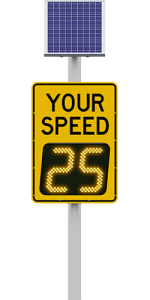
A: SpeedCheck driver feedback signs have a "High-Speed-Cutoff" feature which, if enabled, causes the radar speed sign to go blank with excessively high speeds. Another option will cause the radar speed sign to flash the speed limit when an excessive speed is reached.
Q: Will it set off radar detectors?
A: Yes, the speed radar unit used is identical to police radar units, and will set off radar detectors just as a Police Radar Gun would. Some believe that this a further advantage, as drivers with radar detectors in their cars will slow down believing that there is a Police Officer in the area.
Q: Does a SpeedCheck radar speed sign require a License to operate?
A: The SpeedCheck radar speed signs are certified under FCC Part 15 regulations. What that means to you is that, unlike speed radar of old, no operating license is required.
Q: How do SpeedCheck radar speed traffic signs compare to other traffic calming methods?
A: A very substantial number of Traffic Engineers have concluded that SpeedCheck radar speed signs provide the best of all worlds.
Q: There are cheaper products out there—why does the SpeedCheck cost more?
A: Every SpeedCheck radar speed sign utilizes multiple design elements (some rather expensive) which make them far more visible and power efficient than other radar speed signs that use conventional anti-glare, and contrast enhancement techniques.
SpeedCheck radar speed signs are designed for a high degree of vandal resistance. For example, on our most popular SpeedCheck model, the display window will deflect up to 2 inches without damage! This allows it to absorb a powerful blow from a projectile.
SpeedCheck radar speed signs are designed to meet all federal standards. Therefore they're acceptable for projects that involve any of the many federal grant funds that are available.
SpeedCheck radar speed signs have a proven record of reliability, and are built by a company that is used to building products for professional grade applications.
A: With our first generation of SpeedCheck radar speed signs in 1996, we saw a safety problem that disturbed us. As they drove past, a high percentage of drivers would crane their necks to watch the radar speed sign until they were right beside it. With them looking to the side of the road rather than at the road ahead, this was a serious safety concern. Especially when this was happening right at the place where we were most concerned about getting them to pay attention to the road ahead!
In 1999, we developed our SafetyMask system for the 2nd generation SpeedCheck products, and we've subsequently improved it in our 3rd generation radar speed signs. SafetyMask allows us to limit viewing to a carefully defined area within the driver's normal forward field of view. The result is a dramatic reduction in the rubbernecking problem, getting driver's attention back where we want it, on the road ahead.
In no area do we differ more greatly with our competitors than with the claim that a wide viewing angle is actually a benefit. Our observation of driver behavior showed that it is in fact a potential danger. Rubbernecking drivers are not focused on the hazard zone ahead, and we designed the SpeedCheck SafetyMask specifically to eliminate this risk.
Q: Your Competitor says their radar speed sign has better daytime visibility.

A: In direct comparison in even the worst conditions, our displays constantly receive rave reviews and accolades. (Our SpeedCheck-1520 display is shown in the middle in the top right photo, and on the left in the bottom photo.)
Q: How could SpeedCheck be that much better than the others?

A: Fifteen years ago, we (and other manufacturers of outdoor signs) used mechanical displays. We did so in spite of the potential for mechanical problems and the sun fading of the reflective material, because at that time mechanical displays still provided better view-ability in bright sunlight than LEDs.
At that time, LED displays were not yet able to overcome the intensity and reflections of direct sunlight. We continued to use LEDs only on displays designed for indoor use, until we had completely solved the problems of glare and poor contrast that were caused by direct sunlight.
In our 2nd generation sign, after a considerable amount of development of the technologies that make up our UltraClear contrast enhancement feature, we were finally able to reliably produce the extremely high contrast ratio necessary for LEDs to consistently outperform mechanical displays, even in bright direct sunlight.
In bright direct sunlight, new mechanical displays can provide good visibility, and are better than common LED type outdoor displays. But the 2nd and 3rd generation SpeedCheck displays with UltraClear provide far better visibility than electromechanical displays. In addition, SpeedCheck displays do not degrade from exposure to sunlight as mechanical displays do, and have no moving parts to wear, stick, or break.
Q: I'm concerned about vandalism. Can SpeedCheck radar speed signs withstand abuse?
A: You bet! The 3rd generation SpeedCheck-1520F feature a shatter-proof window in combination with an internal display mechanism that will deflect up to 2 1/2 inches to absorb an impact without damage!
Q: What is the warranty on a SpeedCheck radar speed sign?
A: None better! All SpeedCheck products are warranted for two years, and the LED display boards are warranted for eight years from the date of delivery. An extended warranty is available.
Q: Do the SpeedCheck radar speed signs meet all federal highway regulations?
A: Yes, as of this writing IDC is one of three manufactures to meet all federal highway regulations and are acceptable for grant funding. You can read more about this in "The Numbers Game" article in our Succes Stories section.
Q: What if something does go wrong, are they difficult to repair?
A: SpeedCheck radar speed signs are easy to repair in the field. Simply remove two vandal-resistant fasteners to gain access to all internal components. Self-test functionality and a troubleshooting card inside the display housing allow un-trained personnel to quickly troubleshoot any problem. All components are easily replaced in just a few minutes.
Q: What's the lowest cost power option?
A: With the cost of installation factored in, you will probably find solar power to be the lowest total cost option in every case except where AC power is readily available on the pole. Often, we are finding that our Easy Solar option is the least expensive solution. By limiting nighttime operation through the use of a timer, this radar speed sign uses smaller solar panels, and smaller batteries that are mounted inside the display rather than in a ground vault or other enclosure. The Easy Solar Kit is itself less expensive, but the greatest savings with these units is a result of the far simpler installation as compared to grid powered units or standard solar units that are designed to operate 24 hours a day.
As with all solar installations, these units still need to be sized properly for your location, and are somewhat less expensive for Southern climates where more winter sunlight is available (hence a smaller solar panel can be used). They are available for use anywhere within the lower 48 States, and, as with all of our solar powered radar speed signs, are guaranteed to operate 365 days a year.
Q: How much will it cost to install?
A: Installation costs can vary dramatically. Typical installations use a standard 4" pole, either buried or mounted to a base that meets your local standards. The greatest cost variable is typically that of getting power to the radar speed sign. AC grid connections can range from the very simple, as when connecting to existing power inside the pole on which the sign is to be mounted, to the very complicated, involving road crossings, utility location, site repairs, lost time, etc.
In the former case, there is no question that an AC powered unit is the way to go. But in the case of even fairly simple underground power runs, a Solar Powered radar speed sign may very well be substantially less expensive than an AC powered unit due to the savings on installation cost. Our Easy Solar radar speed signs are designed specifically to minimize the overall cost by eliminating a tremendous amount of installation labor.
A: Yes. Order our Quick-Move option and as many additional Quick-Move pole mounting bracket kits as needed. Additional brackets are mounted to each of the poles where you want to mount the radar speed sign. Power can be provided by Solar Panels, AC power, or even Batteries. Moving the radar speed sign is then a very simple matter requiring no tools, only a key to a padlock.
This allows you to purchase only what you can afford right now, and then purchase additional radar speed signs over the coming years as local or grant funds become available. The Quick-Mount brackets are perfectly suitable for long term mounting as well.
Q: We can't afford it — do you know of any grant money available?
A: Currently, there is a great deal of funding available for Pedestrian and Bicycle Safety programs. Individual states have many of their own safety grant programs available, and the single largest source of grant funds is the NHTSA Safe Routes To School program (which is also administered at the state level). To locate your state's safety grant coordinator, check your Department of Transportation's website, or contact them directly.
We maintain a database of grant sources on a state by state basis as well, so if you are having trouble finding information on grants in your area, please feel free to give us a call or email our Grant Coordinator.
Q: We've never applied for a grant before, can you help us?
A: Absolutely, we have some helpful information on applying for grants, including contacts.
Better yet, we may be able to put you in touch with others within your state who have received similar grants. Others have found this very helpful, as those people within your state who have been through the process can often provide very specific information about the grant application process within your own state. Please call or email our Grant Coordinator for more information.
Q: Do you have a leasing or rental program?
A: Yes, both are available. Please contact us for details.
Q: Any other ideas on how to pay for it?
A: Many communities have found that local businesses and civic organizations are very responsive to the call for increased safety for our kids. And very typically, if you can gather local support, the state will pitch in.
Typically, local civic organizations are very familiar with the fundraising process, and have a great many contacts within the community whom they can call on to find a local civic organization that will take the ball and run with it.
Some of the advantages that you have to offer local businesses to encourage them to donate funds:
Car dealers seem especially receptive. There is an obvious connection, and car dealers are typically very publicity aware and dependent upon maintaining a good name in the community. Other businesses that are highly reliant on good public relations are also good prospects.
You may find that you already have many links to the local business people who can help you:
It is sometimes surprising how many businesses and organizations are willing to donate to a cause that they see as so positive.
Q: Does the SpeedCheck radar speed traffic sign run all hours, or just at certain times?
A: You can choose to have either 24-7, or timed operation. There are two main reasons to use a timer controlled unit:
Q: What size SpeedCheck radar speed sign should I order?
A: Our SpeedCheck-1820F is dimensioned to MUTCD Expressway specifications, with 18 inch high digits and 36 by 48 inch sign dimensions. These signs are typically used on roadways with 45 MPH & greater speed limits. At 36 by 48 inches, the "1820" is almost always too obtrusive for neighborhood and school zone applications.
For neighborhoods and school zones, the MUTCD specifies that the absolute minimum sign size allowed is 24 x 30 inches (12" high digits), and it provides for larger dimensions in increments of six inches "where speed, volume, or other factors result in conditions where increased emphasis, improved recognition, or increased legibility would be desirable" [2003 MUTCD 2B.03].
Some of our competitors continue to offer a "12 inch" display. Our first SpeedCheck display, was designed to these minimum specifications, with 12 inch high digits and a 24 x 30 inch sign. But our customers often felt that these displays were just too small to be noticed.
Our SpeedCheck 1520 was designed to replace the "12 inch" display. With 15 inch high digits and a 30 x 42" sign, it has become the overwhelming choice of our customers for school zones, neighborhoods and playground areas. The 30 x 42 inch sign of our 1520 model is 75% larger than the MUTCD minimum. It provides dramatically improved visibility, yet it is not inappropriately large for this application, as is the case with the 36 x 48 inch sign of our SpeedCheck-1820F model.
Because virtually everyone has switched over to the larger 1520 display with its increased visibility, we have discontinued the 24" x 30" model.
Q: How much power does it take to operate?
A: The actual amount of power consumed over a period of time depends upon a number of factors. Principal factors are:
For a SpeedCheck sign that is connected to AC grid power and operating 24/7, the power consumed will range from 80-120 kilowatt-hours annually. Based on an electricity cost of 12 cents per kilowatt-hour (a very high electricity cost estimate at the time of this writing), the cost to operate would be in the range of $10-15 per year.
Power consumption is of far greater concern when the display is powered by solar panels. Reduced power consumption means lower cost solar power hardware which means a lower overall cost. We address this in the SpeedCheck radar speed sign with a number of different technologies designed to work together to minimize power consumption. Together, these technologies produce impressive results...our displays consume 1/2–2/3 the power of competitive products!
Reduced power consumption means that SpeedCheck delivers a direct customer savings by reducing your investment in solar power equipment. It also means that we can often provide a SpeedCheck radar speed sign solution that operates reliably on solar power in low sunlight areas where competitive products will not.
Q: Is Solar Power an option for my location?
A: We've designed solar powered installations to operate year-round in every conceivable location, and we can do the same for you. Properly designed, solar power is an option, and will operate 365 days a year without fail, whether you're in Phoenix or Seattle, Boca Raton or Buffalo.
But, one size does not fit all. An engineer from Seattle reached the conclusion that solar power wouldn't work in his area, because a unit that he purchased from someone else did not work in the winter time. A solar installation must be designed for your specific location, traffic, and operating conditions. If not, you may be paying too much for capacity you don't need, or, like the engineer from Washington, you may find yourself, when the days get short and gray, with an inoperative system.
The current SpeedCheck radar speed sign is a 3rd generation product designed with solar power as a foremost consideration. We have combined multiple technologies to achieve, by far, the lowest power consumption. This combination of energy saving technologies is what makes solar powered installations feasible virtually anywhere.
In most cases, the question comes down to whether solar powered SpeedCheck installations are more cost effective than grid connected installations for your specific projects. Please see also "How much will it cost to install?" above.
Q: How do we accurately design a solar power system?
A: Although we do the hard work for you, it is important that you understand that a reliable solar power system is not a simple thing to design for two reasons:
To accurately assess your requirements for a solar panel, we will ask you some questions concerning the traffic flow, hours of operation and certain characteristics of the location(s) of installation. We will combine this information with weather data for your location that we collect from the Department of Energy and do the required calculations to determine the requirements for a solar powered installation that will work. Not just "most of the time", but all of the time!
* IMPORTANT: Determination of the amount of sunlight that is available is not as simple as one might hope. Some of the most readily available and commonly used data does not include the worst-case information that is needed for this type of installation. We've seen errors in this data of over 200% over-estimation of available sunlight! Solar installations that are designed based on this data will almost always be inadequate for winter operation—they WILL fail in the winter months! For accurate "solar irradiance" information, we use exclusively data provided by the Department of Energy which has been collected over a period of 30 years. If you need to know the proper conservative Department of Energy solar radiation data for your area, feel free to give our engineering department a call.
To have us design a solar powered installation that will work NO MATTER WHAT, fill out the solar power design form and email, fax or call it in to our engineering department.
Q: Are SpeedCheck radar speed signs FCC approved?
A: All radar speed signs must be FCC approved, and must display an identification plate with the appropriate FCC information. SpeedCheck radar speed signs are FCC approved and carry the required identification plate.